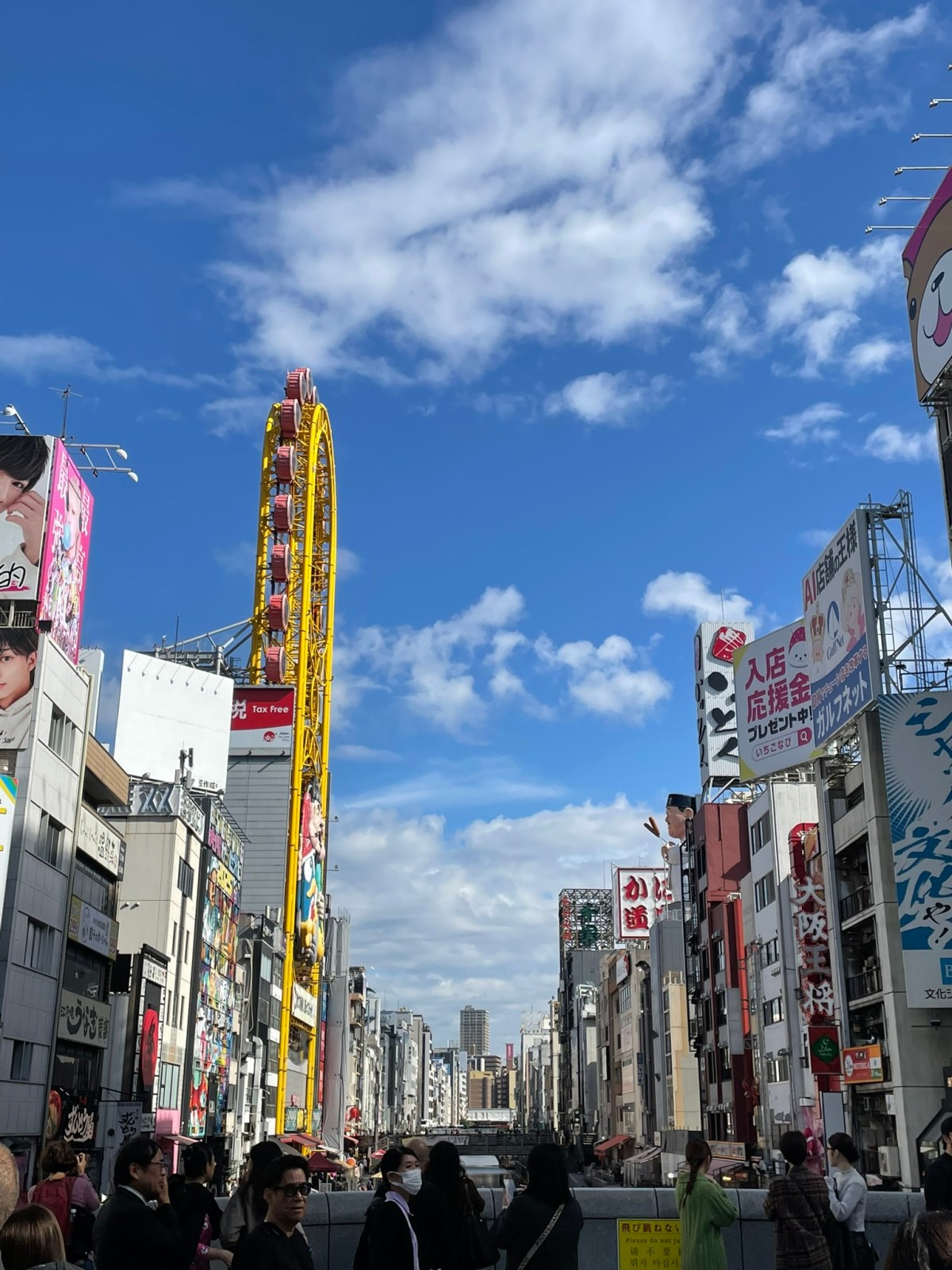
Osaka is a great city during the day.
But I think it becomes itself at night.
Once the sun disappears, the city feels different. The streets get louder, the signs get brighter, the restaurants start filling up, and the neighborhoods seem to loosen their grip a little. Osaka stops feeling like a place you are supposed to admire and starts feeling like a place you are supposed to join.
That is what stood out to me most during my 2025 trip.
I had spent plenty of time in Tokyo by that point, and Tokyo will probably always be the city in Japan that feels most familiar to me. But Osaka gave me something different. It felt rougher around the edges, more lived in, more casual and, in a strange way, more freeing.
And nowhere did that feeling come through more clearly than at night.
The City Changes Once the Lights Come On
During the day, Osaka is busy in the same way most major Japanese cities are busy. Trains are packed, shopping streets are moving, tourists are bouncing from one attraction to another and everyone seems to have somewhere to be.
At night, that energy changes.
In places like Namba and Dotonbori, the streets come alive in a completely different way. Neon signs reflect off the pavement. Music spills out from bars. Restaurant doors keep opening and closing. People are standing outside trying to decide where to eat next.
There is noise everywhere, but it does not feel overwhelming.
It feels inviting.
You start walking without much of a plan. Maybe you are heading toward a restaurant. Maybe you are looking for another drink. Maybe you are just following a side street because it looks interesting.
That kind of wandering feels natural in Osaka.
Some of my favorite moments were not the big attractions. They were the stretches between them.
A narrow alley. A tiny izakaya. A bar with only a few seats. A restaurant packed with locals and travelers all trying to squeeze in for one more plate of food.
Osaka rewards curiosity at night.
It Feels More Relaxed Than Tokyo
Tokyo can feel polished.
Even when it is chaotic, there is an order to it. Everything seems intentional. The trains run like clockwork. The major neighborhoods are enormous, bright and almost impossibly organized.
Osaka feels different.
It feels like the city is willing to let its hair down.
There are places where the walls look a little older, the alleys are a little tighter and the streets feel like they have been used hard for decades.
I mean that as a compliment.
Osaka feels lived in.
It does not always feel like it is trying to impress you, and that may be why it is so easy to relax there.
At night, especially around Namba, that personality becomes obvious. Locals are out eating, drinking and moving from place to place. Foreign travelers are doing the same thing. Everyone seems to blend together around food and conversation.
There is less pressure to feel like you are “doing Osaka correctly.”
You can just be there.
Food Is the Center of Everything
If there is one thing Osaka does especially well at night, it is food.
Not fancy food for the sake of being fancy.
Food that makes you want to keep eating even when you know you are full.
During my trip, some of the best nights revolved around moving from one place to another and trying something different at each stop.
An izakaya for grilled meat.
Another stop for takoyaki.
A small restaurant tucked into a side street.
A drink somewhere you probably never would have found on your own.
Then maybe one more stop because nobody wants the night to end yet.
That rhythm suits Osaka perfectly.
You do not necessarily need one big dinner reservation.
Sometimes the better experience is to treat the entire neighborhood like dinner.
Have a little food here, a drink there, walk for fifteen minutes, then find something else.
By the end of the night, you have not just eaten well.
You have experienced the city.
The Back Alleys Are Where Osaka Gets Interesting
Dotonbori gets most of the attention, and for good reason.
The giant signs, crowds and river make it one of the most recognizable places in Japan.
But the Osaka I enjoyed most was often one or two turns away from the main streets.
That is where the city starts feeling more personal.
Walk down one of the back alleys and suddenly the giant crowds disappear. The restaurants get smaller. The signs get harder to read. You start seeing places that seem to have been serving the same neighborhood for years.
Those streets are made for nighttime photography, too.
The lanterns, neon, steam coming out of restaurant doors and constant movement give Osaka a texture that is hard to describe until you see it for yourself.
It does not look perfect.
That is exactly why it looks so good.
Osaka at night has character.
The Best Nights Are the Ones You Do Not Overplan
I think that is the biggest reason Osaka feels so good after dark.
It encourages you to stop trying to control everything.
You do not need a checklist of ten bars.
You do not need to know exactly where you are eating three hours from now.
You do not need to turn the night into another sightseeing schedule.
Pick a neighborhood.
Start walking.
Eat when something smells good.
Step into a small bar if it looks interesting.
Turn down the alley that seems like it might lead somewhere.
Take your time.
Tokyo often makes me want to see more.
Osaka makes me want to stay out longer.
There is a difference.
By the time I was walking back through Namba at the end of the night, surrounded by glowing signs, busy restaurants and people still moving from one place to the next, I understood why Osaka has such a strong personality.
The city does not really ask you to stand back and admire it.
It asks you to participate.
And after dark, that is when Osaka is at its best.
Make sure to see my other post about the 8 things you should see after dark in Osaka.


