There’s one train ride from my last trip to Japan that I find myself returning to more than any other. It wasn’t my first time on the Shinkansen, and it wasn’t even the longest journey I took. But something about that ride — moving from Osaka back to Tokyo — has stayed with me in a quiet, persistent way.
I remember boarding the Nozomi with a sense of calm I didn’t expect. Osaka had been vibrant, loud in the best ways, full of energy and movement. Tokyo was waiting on the other end — familiar, layered, endlessly fascinating itself. Between the two was a stretch of Japan I would only ever see from a window.
I took a seat on the left side of the train, knowing there was a chance — not a guarantee — of seeing Mount Fuji on the way back to Tokyo. That uncertainty felt fitting. In Japan, some of the most meaningful moments aren’t promised. You show up, you wait, and you let things reveal themselves or not.
As the train pulled away, the city gave way to suburbs, then to open stretches of land and countryside. Small towns passed by in quick succession — clusters of buildings, narrow roads, quiet neighborhoods that flashed into view and disappeared just as quickly. I found myself wondering about the lives unfolding there. Morning routines, local shops, familiar commutes. Entire worlds existing just out of reach, never meant for me to fully know.
There was something comforting about that.
Travel often encourages us to collect experiences, to check places off a list. But watching those towns blur past reminded me that mystery is part of what makes a place feel alive. You’re not meant to see everything. Some stories stay untold, and that’s okay.
The speed of the train didn’t feel rushed. It felt purposeful. Smooth. Controlled. Inside the car, everything was quiet. People read, rested, stared out the window just like I was. No one made a moment out of the moment. It simply existed, shared among strangers moving in the same direction.
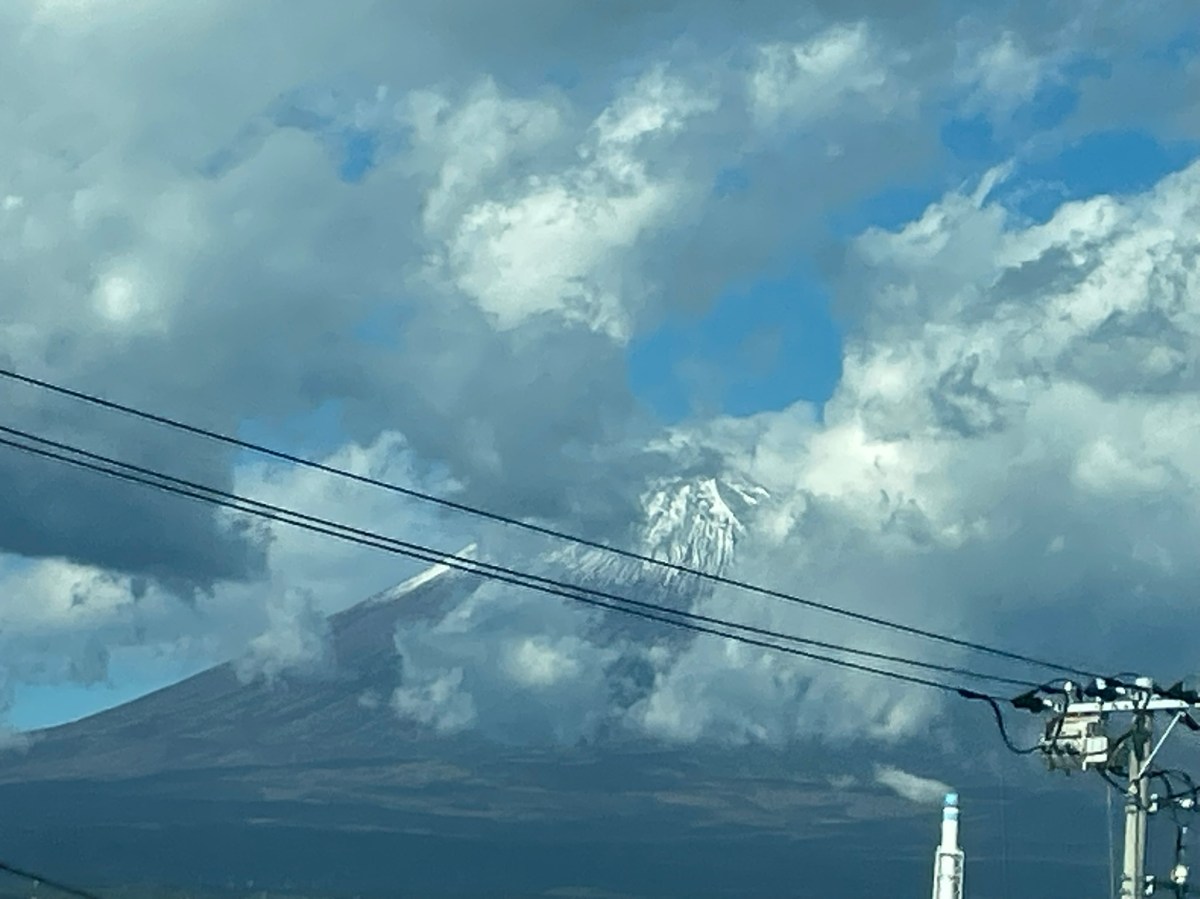
Then, almost casually, it appeared.
Mount Fuji came into view for a brief moment of time — unmistakable, steady, and distant. I lifted my camera instinctively, capturing a few frames as the landscape continued to rush past. And just as quickly as it appeared, it was gone again, hidden behind buildings and mountains and time.
That fleeting glimpse made it feel even more special.
Fuji didn’t demand attention. It didn’t announce itself. It showed up on its own terms, reminding me that not everything meaningful lingers long enough for you to fully grasp it. Some things are powerful precisely because they don’t.
As the train continued toward Tokyo, I thought about how perfectly that ride reflected the way Japan moves. There’s efficiency, yes — incredible efficiency. But there’s also restraint. A sense that things don’t need to be exaggerated to be impressive. The journey itself carries weight, even when nothing dramatic happens.
Navigating cities like Osaka and Tokyo can feel intimidating at first. The scale, the rail networks, the constant movement — it’s easy to think you need to understand everything immediately. That ride taught me the opposite. You don’t need to know every detail. You need a destination, a willingness to observe, and the patience to let the rest unfold.
Watching the countryside pass by at speed, I realized how much beauty exists in places I’ll never stop in, never walk through, never truly know. And instead of feeling regret, I felt gratitude. Japan doesn’t ask you to conquer it. It asks you to move through it with respect.
That train ride didn’t change my plans or my itinerary. It changed how I thought about movement, about distance, about what it means to witness something without owning it.
I arrived in Tokyo feeling grounded, not depleted. As if the journey itself had prepared me for whatever came next.
It was just a train ride.
And somehow, it was everything.

 Travels With Matt Blog